


- Arora Eye Centre
- Posted on
Cataract does not always begin with a dramatic change in vision. For many people, it starts quietly: reading becomes slightly more difficult, headlights appear brighter at night, colours seem less vivid, or the spectacle prescription keeps changing.
Because these changes can develop gradually, they are often mistaken for a normal part of getting older.
But persistent changes in vision deserve an eye examination.
For people searching “cataract eye symptoms,” “eye doctor near me,” “best cataract hospital in Karnal,” or “eye hospital near Karnal,” understanding the early signs of cataract is an important first step.
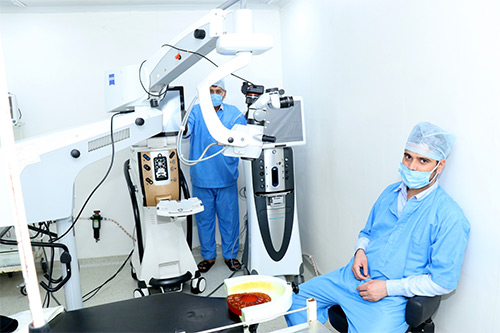
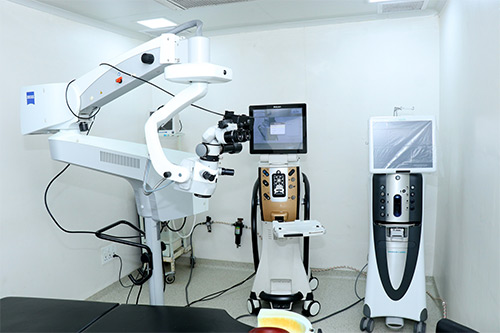
At Arora Eye & LASIK Laser Centre, Karnal, cataract care is one of the centre’s major ophthalmic services. The centre lists advanced cataract technologies including LensX Blade-Free Robotic Cataract Surgery, the Alcon Centurion Vision System and IOL Master 700. Its published services also include comprehensive ophthalmology, glaucoma, retina, refractive surgery, cornea, pediatric ophthalmology, squint and oculoplasty.
The question for a patient, however, is not simply whether cataract treatment is available.
The important question is:
When should you stop changing your glasses and get your eyes properly examined?
What Are the Early Symptoms of Cataract?
Cataract occurs when the natural lens inside the eye becomes cloudy. The change may develop gradually, so a person may adapt to declining vision without immediately recognising that cataract could be responsible.
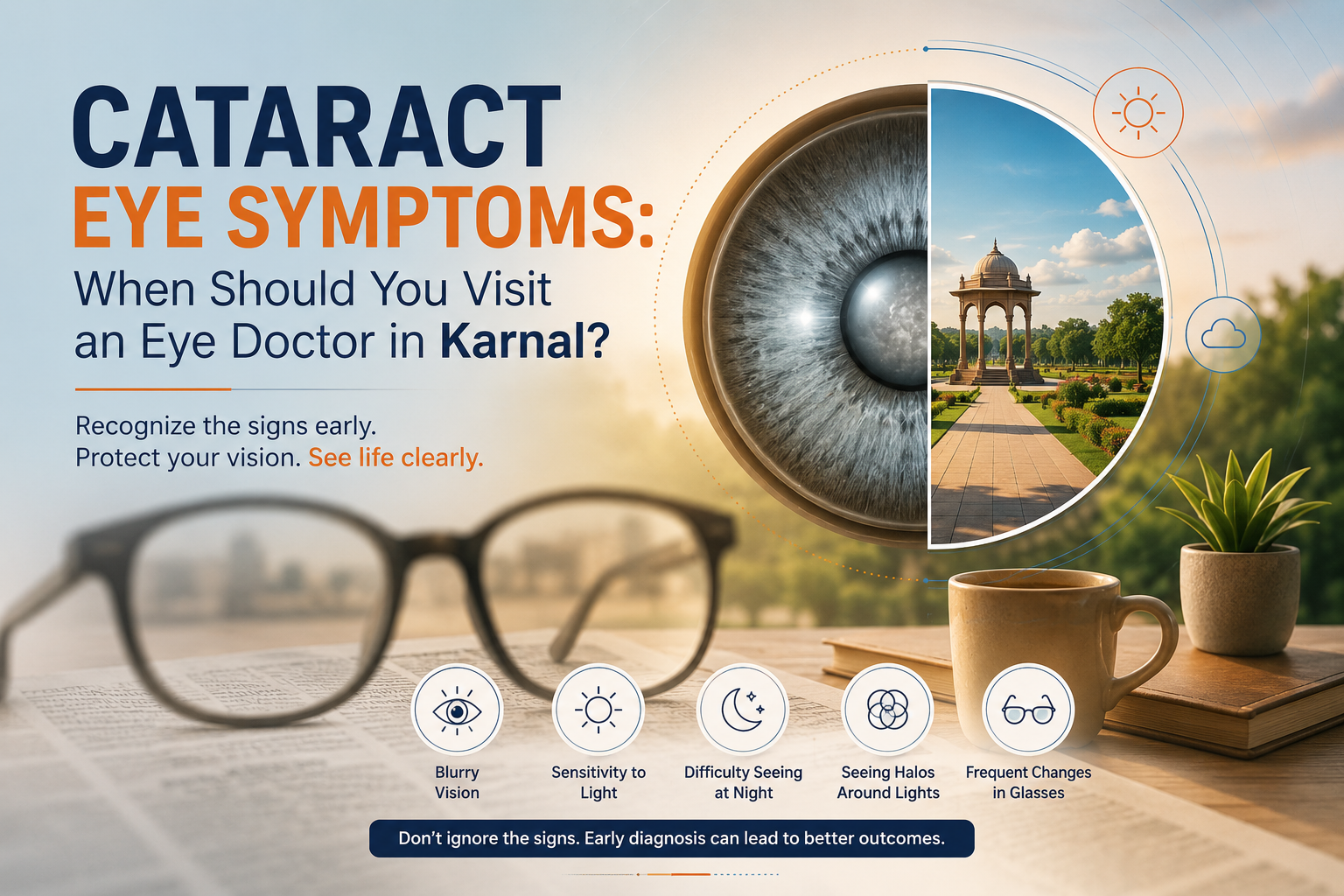
Common symptoms can include:
1. Cloudy or Blurred Vision
One of the most common complaints is that objects no longer look as clear as they once did.
A person may notice difficulty reading signs, recognising faces from a distance, watching television or performing detailed work.
Changing spectacles may temporarily appear to help, but if the underlying problem is cataract, simply changing the prescription will not remove the cloudy natural lens.
2. Difficulty Seeing at Night
Night driving can become uncomfortable.
Headlights may appear excessively bright, and the patient may feel that roads or objects are not as clear as before.
If night vision is becoming progressively difficult, an eye examination can help determine whether cataract or another eye condition is responsible.
3. Increased Glare and Light Sensitivity
Some people become increasingly uncomfortable around bright lights.
Sunlight, vehicle headlights or strong indoor lighting may produce more glare than they previously did.
This can be particularly noticeable while driving after sunset.
4. Colours May Appear Less Bright
Cataract can affect the way colours appear.
A patient may feel that colours look duller or less vivid than before.
This change can happen gradually, making it difficult to identify until one eye is compared with the other or the patient undergoes a detailed eye examination.
5. Double Vision in One Eye
Double vision can have several causes and should not automatically be attributed to cataract.
However, the centre’s cataract information identifies double vision in one eye among symptoms that may occur with cataract.
Because double vision can have different causes, a comprehensive ophthalmic examination is important.
6. Frequent Changes in Spectacle Power
A repeated need to change glasses can sometimes be a sign that something more than a simple refractive change is occurring.
If the spectacle prescription continues changing and vision remains unsatisfactory, the patient should have the eyes examined rather than repeatedly replacing glasses.
Cataract Symptoms Can Look Like an Ordinary Change in Spectacle Power
This is one of the reasons cataract can remain unnoticed for some time.
A person may say:
“My glasses are no longer working.”
Then a new prescription is made.
After some time, the patient experiences the same problem again.
If this happens repeatedly, a comprehensive eye examination is worthwhile.
An ophthalmologist can assess the lens, retina, cornea, optic nerve and other structures of the eye to determine why vision has changed.
This is particularly important for older adults because reduced vision is not always caused by cataract. Other conditions, including glaucoma and retinal disease, can also affect vision.
When Should You See an Eye Doctor for Cataract Symptoms?
There is no need to wait until vision becomes severely impaired.
You should consider an ophthalmic evaluation when changes in vision begin interfering with everyday activities such as:
- Reading
- Driving
- Recognising faces
- Watching television
- Using a computer
- Moving around in unfamiliar places
- Working in low-light conditions
- Seeing road signs
- Performing detailed household or professional tasks
The decision to undergo cataract surgery should be based on the patient’s symptoms, visual requirements and examination findings—not simply on age.
Does Everyone With Cataract Need Surgery?
No.
The presence of a cataract does not automatically mean that surgery is immediately required.
The timing of cataract surgery depends on how much the cataract is affecting vision and daily activities, along with the ophthalmologist’s clinical assessment.
Some patients with an early cataract may continue with observation and updated glasses for a period of time.
When cataract begins significantly affecting daily life and the ophthalmologist determines that surgery is appropriate, cataract removal may be considered.
This is why an eye examination is more important than deciding about surgery based on an online article.
Cataract Surgery in Karnal: What Has Changed?
Cataract surgery has developed considerably with advances in diagnostic and surgical technology.
Modern cataract care involves more than removing the cloudy lens.
Before surgery, the eye needs to be measured accurately and the patient’s ocular health needs to be assessed.
The choice of intraocular lens also needs to be considered as part of the surgical plan.
At Arora Eye & LASIK Laser Centre, the centre’s published cataract technology includes:
- LensX Blade-Free Robotic Cataract Surgery
- Alcon Centurion Vision System
- IOL Master 700
These technologies are specifically highlighted by the centre as part of its cataract-care infrastructure.
For a patient searching for the best cataract hospital in Karnal, this makes it important to look beyond a simple claim of “advanced cataract surgery.”
Patients should understand what technology is being used, why it is being recommended and whether it is appropriate for their individual eyes.
What Is Blade-Free Robotic Cataract Surgery?
The centre lists LensX Blade-Free Robotic Cataract Surgery among its cataract technologies.
Technology-assisted cataract surgery is designed to provide computer-controlled precision during selected stages of the procedure.
However, patients should understand an important point:
Having advanced technology available does not mean every patient requires the same technology.
The appropriate surgical approach depends on the patient’s eye condition, measurements, cataract characteristics and surgeon’s clinical assessment.
Therefore, the correct question is not simply:
“Does the hospital have robotic cataract surgery?”
A more useful question is:
“Is this technology appropriate for my eyes and my planned cataract surgery?”
Why Accurate Eye Measurements Matter Before Cataract Surgery
Cataract surgery involves replacing the eye’s cloudy natural lens with an intraocular lens.
Accurate measurements are therefore an important part of surgical planning.
Arora Eye & LASIK Laser Centre lists the IOL Master 700 among its cataract technologies.
For patients, this is one reason a comprehensive pre-operative assessment matters.
The ophthalmologist needs to understand the eye before recommending the surgical plan and appropriate lens option.
Premium Cataract Lenses: Why the Choice Should Be Individual
Not every cataract patient has the same visual expectations.
Consider two patients of the same age.
One may spend much of the day reading.
Another may spend significant time driving.
Another may use a computer regularly.
Another may be comfortable wearing spectacles after surgery.
These differences matter when discussing intraocular lens options.
The right lens choice depends on factors including ocular health, measurements, visual expectations and the patient’s lifestyle.
A premium lens should therefore not be selected simply because it is called “premium.”
It should be selected when the patient’s eyes and visual requirements make it appropriate.
Cataract Surgery Is Not Only About the Lens
A patient searching for “best cataract hospital near me” may focus primarily on the surgery.
But the complete patient journey includes:
Diagnosis → Eye measurements → Cataract assessment → Retinal and ocular health evaluation → Lens discussion → Surgery → Post-operative care
Each stage matters.
This is particularly important for older patients who may have additional conditions such as diabetes, glaucoma or retinal disease.
A comprehensive eye centre can evaluate these conditions as part of the patient’s overall ophthalmic care.
Why Retina Evaluation Can Matter Before Cataract Surgery
Cataract is not always the only reason for poor vision.
For example, a patient may have both cataract and a retinal condition.
Removing the cataract may improve the amount of light reaching the retina, but the final visual result can also depend on the health of the retina and optic nerve.
This is why comprehensive ophthalmic assessment is important before cataract surgery.
Arora Eye & LASIK Laser Centre provides retina services in addition to cataract care. The centre lists medical and surgical retina among its services, and its NABH accreditation scope includes both Medical Retina Services and Surgical Retina Services.
Read more:
https://aroraeyecentre.in/arora-eye-lasik-laser-centre-the-best-retina-hospital-in-karnal/
Diabetes and Cataract: Why Eye Evaluation Becomes More Important
People with diabetes can develop several eye complications, including diabetic retinal disease.
A diabetic patient preparing for cataract surgery may therefore require retinal evaluation as part of comprehensive eye care.
The presence of cataract does not eliminate the importance of monitoring the retina.
If you have diabetes and are experiencing blurred vision, changing spectacle power or difficulty seeing at night, do not assume cataract is the only possible cause.
An ophthalmologist can determine whether cataract, retinal disease, refractive error or another condition is contributing to the vision change.
Cataract and Glaucoma Can Occur in the Same Patient
Older adults can have more than one eye condition at the same time.
A person may have cataract as well as glaucoma.
This is another reason why a comprehensive eye examination is preferable to assuming every change in vision is caused by cataract.
Arora Eye & LASIK Laser Centre lists glaucoma among its major specialties, and glaucoma services are also included within its current NABH accreditation scope.
If a patient already has glaucoma, the ophthalmologist should consider the glaucoma status while planning overall eye care.
When “Eye Doctor Near Me” Should Become “Cataract Specialist Near Me”
A general eye examination is a useful starting point.
But when cataract is suspected, patients may want to consult an ophthalmologist experienced in cataract assessment and surgery.
The centre’s published doctor information includes Dr. Sanjeev Arora, listed as Founder Director with expertise in ophthalmology, cataract and LASIK surgery. The centre also lists other specialists across ophthalmic subspecialties.
The centre states that it has more than two decades of experience in eye care and a team of super-specialist doctors.
Why Karnal Patients Can Consider Local Specialist Eye Care
Patients from Karnal and surrounding areas do not necessarily need to travel to Delhi or Chandigarh for every specialist eye-care requirement.
A comprehensive eye centre in Karnal can be particularly convenient when treatment requires multiple visits.
Arora Eye & LASIK Laser Centre is located at:
650, Sector 7, Urban Estate, Karnal, Haryana – 132001.
The centre’s published working hours are:
Monday to Saturday: 9:00 AM – 7:00 PM
Sunday: 10:00 AM – 2:00 PM.
The Haryana Employees’ State Insurance Health Care department also lists Arora Eye & Lasik Laser Centre among empanelled hospitals in Karnal.
Patients should confirm their individual eligibility and applicable insurance or scheme terms directly with the hospital before treatment.
What Should You Ask Your Eye Doctor About Cataract?
During a cataract consultation, patients can ask:
“Is cataract definitely causing my vision problem?”
This helps distinguish cataract from other eye conditions.
“How advanced is my cataract?”
Understanding the examination findings can help the patient make an informed decision.
“Do I need surgery now?”
The decision should consider symptoms and daily-life impact.
“Which surgical technology is appropriate for me?”
Not every patient requires the same procedure.
“Which intraocular lens options are suitable?”
Lens selection should be based on the patient’s eyes and visual requirements.
“Do I have any retinal, glaucoma or corneal problem?”
Other eye conditions can influence the treatment plan.
“What follow-up will I need after surgery?”
Post-operative care is an important part of the treatment journey.
Frequently Asked Questions About Cataract Eye Symptoms
1. What are the early symptoms of cataract?
Early cataract symptoms can include cloudy or blurred vision, difficulty seeing at night, glare, faded colours, double vision in one eye and repeated changes in spectacle prescription. A comprehensive eye examination is required to confirm whether cataract is responsible.
2. Can cataract symptoms be corrected by changing glasses?
Changing glasses may improve vision when the problem is refractive error, but spectacles cannot remove a cloudy natural lens. If vision remains blurred despite updated glasses, an ophthalmic examination is advisable.
3. When should I see an eye doctor for cataract?
You should consider an eye examination when blurred vision, glare, difficulty driving at night, reduced reading ability or other visual changes begin affecting everyday activities.
4. Is cataract surgery available in Karnal?
Yes. Arora Eye & LASIK Laser Centre provides cataract services in Karnal and lists advanced technologies including LensX Blade-Free Robotic Cataract Surgery, Alcon Centurion and IOL Master 700.
5. What is Blade-Free Robotic Cataract Surgery?
It is a technology-assisted approach to cataract surgery. Whether it is appropriate for an individual patient depends on the eye examination, cataract characteristics and surgical plan.
6. How do I choose the best cataract hospital in Karnal?
Consider the ophthalmologist’s cataract experience, diagnostic capabilities, surgical technology, lens options, accreditation, follow-up care and the hospital’s ability to manage other eye conditions that may affect vision.
7. Can diabetes affect cataract surgery planning?
Diabetes can be associated with retinal disease, so diabetic patients may require retinal assessment as part of comprehensive eye care. The final surgical plan depends on the patient’s individual eye condition.
8. Can cataract and glaucoma occur together?
Yes. A patient can have more than one eye condition. A comprehensive eye examination can identify cataract as well as glaucoma or other conditions that may contribute to vision changes.
9. Can cataract cause difficulty seeing at night?
Difficulty seeing at night and increased glare can occur with cataract. However, night-vision problems can have several causes, so an eye examination is necessary to determine the reason.
10. Where can I consult an eye doctor for cataract symptoms in Karnal?
Arora Eye & LASIK Laser Centre is located at 650, Sector 7, Urban Estate, Karnal, Haryana – 132001. The centre’s published contact information includes 0184-4036258 and its website provides appointment information.
Related Eye Care Information
If you are researching cataract symptoms, these related resources can help you understand the different areas of eye care available at the centre:
Cataract Treatment in Karnalhttps://aroraeyecentre.in/cataract/
Blade-Free Cataract Surgeryhttps://aroraeyecentre.in/blade-free-cataract/
AI Cataract Surgeryhttps://aroraeyecentre.in/ai-cataract-surgery/
Retina Treatment in Karnalhttps://aroraeyecentre.in/arora-eye-lasik-laser-centre-the-best-retina-hospital-in-karnal/
LASIK & Vision Correctionhttps://aroraeyecentre.in/lasik-laser-eye-surgery-hospitals-in-karnal/
Glaucoma Treatmenthttps://aroraeyecentre.in/glaucoma/
Squint Treatmenthttps://aroraeyecentre.in/squint/
Eye Specialists & Doctorshttps://aroraeyecentre.in/doctors/
Visit Arora Eye & LASIK Laser Centre, Karnal
Arora Eye & LASIK Laser Centre
650, Sector 7, Urban Estate
Karnal, Haryana – 132001
Phone: 0184-4036258
Monday–Saturday: 9:00 AM – 7:00 PM
Sunday: 10:00 AM – 2:00 PM
Official Website – Arora Eye & LASIK Laser Centrehttps://aroraeyecentre.in/
Google Business Profile / Google Listinghttps://share.google/yUPdIehoSVXxJEvE4
If blurred vision, glare, night-vision difficulty or repeated changes in spectacle power are affecting your daily life, do not assume that a new pair of glasses is the only answer. A comprehensive eye examination can identify whether cataract—or another eye condition—is responsible.