


ARORA EYE & LASIK LASER CENTRE — KARNAL, HARYANA
Best Cataract Hospital in Karnal
& Best Eye Hospital in Karnal and Haryana
A Complete Patient Guide to Advanced Cataract Surgery, AI-Guided Biometry & Premium IOL Options
| Primary Keyword | Best Cataract Hospital in Karnal |
| Secondary Keyword | Best Eye Hospital in Karnal and Haryana |
| Optimisation | SEO + AEO + GEO | Internal Links | Schema-Ready FAQs | 3,500+ Words |
| Centre Address | 650, Sector 7 Road, Urban Estate, Karnal, Haryana — 132001 |
| Contact | 0184-4036258 | Contactus@aroraeyecentre.in |
| Website | www.aroraeyecentre.in | Book Appointment: aroraeyecentre.in/book-appointment/ |
Best Cataract Hospital in Karnal — Why Arora Eye & LASIK Laser Centre Leads
Cataracts are the world’s leading cause of preventable blindness. In India, they account for a significant proportion of all avoidable vision loss — yet the condition is entirely treatable with modern surgical techniques that are safe, painless, and completed within a single day. The challenge for most patients is not the surgery itself but choosing the right hospital: one that combines clinical expertise, the most advanced surgical technology, and a transparent, patient-centred approach to care.
In Karnal and across Haryana, that hospital is Arora Eye & LASIK Laser Centre. Located at 650, Sector 7, Urban Estate, Karnal, the centre has built a documented record of cataract surgical excellence over more than 20 years — investing in the Alcon LenSx femtosecond laser, the Carl Zeiss IOL Master 700 AI-guided biometry system, and a portfolio of premium intraocular lenses (IOLs) that give every patient — regardless of their lifestyle and visual goals — the optimal path to clear, spectacle-free vision.
This guide covers every dimension of cataract care at Arora Eye Centre: what cataracts are and how they develop, the full surgical technology stack, the IOL options available, what patients experience before and after surgery, and the 20 most commonly asked questions from patients across Karnal, Panipat, Kurukshetra, Ambala, and Kaithal who are evaluating their options.
20+ Years of Eye Care in Karnal |
20,000+ Successful Eye Surgeries |
6+ Expert Ophthalmologists |
24/7 Emergency Eye Care |
1. Understanding Cataracts — Causes, Symptoms & When to Seek Treatment
The human lens sits behind the iris and pupil, focusing incoming light precisely onto the retina. In a young, healthy eye, this lens is clear and flexible. As part of the natural ageing process — or because of other risk factors — proteins within the lens gradually clump together, creating an area of opacity that scatters and blocks light. This is a cataract.
The consequence is a progressive deterioration of visual quality: images become blurred, colours appear washed out, lights create halos and glare, and tasks like reading, driving at night, or recognising faces become increasingly difficult. At advanced stages, untreated cataracts lead to functional blindness — a tragedy that modern medicine renders entirely preventable.
Common Symptoms of Cataract
- Blurred or hazy vision that does not sharpen with glasses adjustment
- Sensitivity to bright lights, headlamps, or direct sunlight
- Seeing halos or starbursts around light sources, particularly at night
- Colours that appear faded, yellowed, or less vivid than before
- Double vision in one eye (monocular diplopia)
- Frequent changes in spectacle prescription — ‘second sight’ that reverses later
- Difficulty reading fine print even with reading glasses
Who Is at Risk?
Age is the primary risk factor — most cataracts develop in individuals over 55, though nuclear sclerosis (the most common type) can begin in the 40s. Additional risk factors include poorly controlled diabetes, prolonged use of corticosteroid medications, prior eye trauma or surgery, excessive ultraviolet light exposure, and a family history of early-onset cataract. Certain congenital cataracts are present from birth and require urgent paediatric intervention to prevent amblyopia.
The single most important message about cataracts: they are not a condition to ‘watch and wait’ indefinitely. Once a cataract begins affecting your daily activities — driving, reading, working — the optimal surgical window is now. Early-stage cataract surgery is technically simpler, requires less ultrasound energy, and produces superior visual outcomes compared to surgery on a mature, hard, or ‘hypermature’ cataract.
2. Modern Cataract Surgery — A Daycare Procedure That Restores Life
At Arora Eye & LASIK Laser Centre, cataract surgery is performed as a daycare procedure. Patients arrive, undergo surgery, and return home the same day — with most resuming routine activities within 24 to 48 hours of the procedure. There are no stitches, no injections, no bandage in standard modern phacoemulsification.
The foundation of all cataract surgery at the centre is phacoemulsification — an ultrasound-powered technique in which the clouded natural lens is emulsified (broken into tiny particles) and aspirated through a micro-incision of approximately 2.2 to 2.8 millimetres. An intraocular lens (IOL) is then inserted through the same micro-incision and unfolded inside the eye to replace the removed lens. The incision self-seals without sutures. Operating time is typically 10 to 15 minutes per eye.
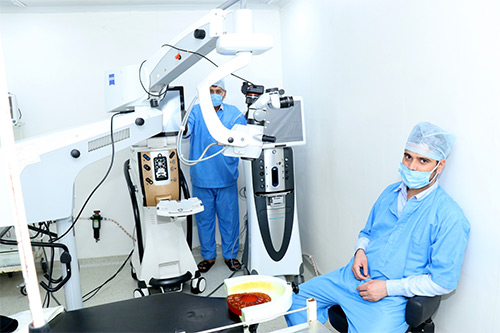
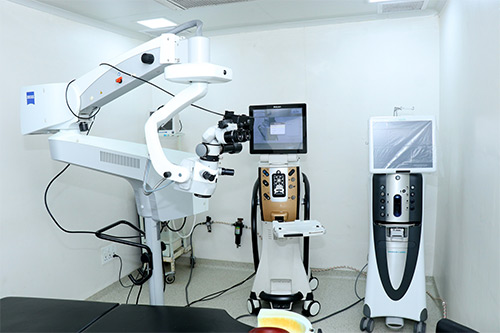
At Arora Eye Centre, phacoemulsification is elevated further by two platforms that add layers of precision and safety that manual technique cannot achieve: the Alcon LenSx femtosecond laser for blade-free cataract surgery, and the Carl Zeiss IOL Master 700 for AI-guided biometry and IOL planning.
3. Alcon LenSx Blade-Free Laser Cataract Surgery — Precision Beyond the Blade
The Alcon LenSx is an image-guided femtosecond laser system designed exclusively for cataract surgery. It is the most widely used and clinically validated femtosecond cataract laser in the world. At Arora Eye & LASIK Laser Centre, it is available as the Blade-Free Cataract option — a significant advancement over conventional manual phacoemulsification.
What LenSx Automates — and Why It Matters
In conventional cataract surgery, three critical steps are performed manually by the surgeon: the anterior capsulotomy (the circular opening in the lens capsule through which the cataract is removed), the lens fragmentation (breaking the hard cataract nucleus), and the corneal incisions. These steps are the most technically demanding in the entire procedure — and the most susceptible to variation.
LenSx replaces manual execution of all three steps with computer-controlled femtosecond laser pulses guided by integrated real-time OCT imaging that maps the internal structures of the eye before each laser pulse is delivered. The result:
- Anterior capsulotomy that is more circular, more centred, and more reproducible than the best-trained human hand can achieve — published data demonstrates circularity exceeding 96% free-floating capsulotomy in clinical series
- Lens pre-fragmentation that reduces the total ultrasound energy (phaco power) needed during the subsequent phacoemulsification step — protecting the corneal endothelial cells and reducing post-operative inflammation
- Three-plane self-sealing corneal incisions of precise geometry — reducing wound-related complications and astigmatic induction
- Markerless toric IOL alignment capability through integration with the ARGOS biometer — improving rotational accuracy for astigmatism-correcting lenses
A more precise capsulotomy means the IOL sits more centred and stable inside the eye — which is directly correlated with better refractive outcomes and greater spectacle independence. For patients choosing premium multifocal or trifocal IOLs, LenSx laser precision is not optional — it is the foundation on which the optical performance of the IOL rests.
Learn more about the Blade-Free Cataract programme at Arora Eye Centre: aroraeyecentre.in/blade-free-cataract/
4. IOL Master 700 — AI-Guided Biometry for Zero Refractive Surprises
The quality of cataract surgery is measured in the post-operative refraction: how close is the patient’s actual visual outcome to the planned target? The answer is determined almost entirely by the accuracy of preoperative biometry — the set of measurements that determine which IOL power to implant. At Arora Eye & LASIK Laser Centre, this step is performed with the Carl Zeiss IOL Master 700 — the global benchmark in optical biometry, available as the AI Cataract Surgery pathway.
What the IOL Master 700 Measures
Unlike conventional biometers that use partial coherence interferometry to measure only the anterior corneal surface, the IOL Master 700 uses swept-source optical coherence tomography (SS-OCT) — scanning the eye in six directions simultaneously at a depth of 44 millimetres. This comprehensive scan delivers:
- Axial length — the precise front-to-back length of the eye, the dominant determinant of IOL power
- Total Keratometry (TK) — measures both anterior AND posterior corneal curvature, dramatically improving accuracy in patients with previous refractive surgery or corneal irregularities
- Anterior chamber depth — the distance between the cornea and the natural lens
- Lens thickness — measured directly rather than estimated
- White-to-white distance — horizontal iris diameter, used for specific IOL formulas
- Foveal fixation confirmation — the device images the fovea to verify the patient is fixating correctly, eliminating a source of measurement error
- Lens tilt detection — identifies unusual lens geometry that would compromise standard formula accuracy
AI-Assisted IOL Formula Selection
The IOL Master 700 integrates directly with advanced IOL calculation formulas — including the Barrett Universal II, Haigis, Haigis-T (for toric IOLs), Holladay 2, and SRK/T. For patients with previous LASIK, PRK, or corneal refractive surgery, the device applies the Haigis-L formula, which specifically corrects the biometric distortions introduced by prior laser treatment.
This AI-assisted calculation generates a precise IOL power recommendation tailored to the individual anatomy of each eye — minimising the residual refractive error after surgery and maximising the probability of achieving the planned visual outcome without glasses.
The IOL Master 700 can successfully measure axial length in dense cataracts (posterior subcapsular opacity grade ≥4) where conventional biometers fail — ensuring that even patients with advanced cataracts receive accurate preoperative planning rather than estimated values.
Explore AI Cataract Surgery at Arora Eye Centre: aroraeyecentre.in/ai-cataract-surgery/
5. Premium IOL Options — Choosing the Right Lens for Your Life
The intraocular lens (IOL) implanted during cataract surgery does not merely replace the clouded natural lens — it is the primary determinant of your vision for the rest of your life. Arora Eye & LASIK Laser Centre offers the complete range of IOL options, from standard monofocal lenses to advanced trifocal and EDOF (Extended Depth of Focus) lenses, matched to each patient’s visual requirements, lifestyle demands, and eligibility.
| IOL Type | Vision Correction | Glasses After Surgery | Best Suited For |
|---|---|---|---|
| Standard Monofocal | Distance or Near — one focal point | Reading glasses usually needed | Budget-conscious patients, uncomplicated cataracts |
| Toric IOL | Distance + pre-existing Astigmatism | Reduced astigmatism correction needed | Patients with significant corneal astigmatism |
| Multifocal / Trifocal | Near, Intermediate & Distance | Most patients achieve glasses independence | Active patients wanting full spectacle freedom |
| EDOF (Extended Depth of Focus) | Extended range — near to distance | Minimal spectacle dependence | Patients with intermediate vision demands (screens, driving) |
How IOL Selection Works at Arora Eye Centre
IOL selection is not a one-size-fits-all decision. The clinical team reviews the IOL Master 700 biometric data alongside the patient’s lifestyle profile — occupation, dominant visual tasks, hobbies, driving habits, and prior dependence on glasses — to recommend the IOL that optimises the patient’s real-world functional vision. Patients choosing toric IOLs benefit from the LenSx laser’s markerless alignment capability, which ensures precise rotational positioning for maximum astigmatism correction.
6. Beyond Cataracts — Complete Eye Care at Arora Eye Centre
As the best eye hospital in Karnal and Haryana, Arora Eye & LASIK Laser Centre does not confine itself to cataract surgery. The centre operates as a full-spectrum ophthalmic institution, with dedicated clinical programmes across every major subspecialty of eye care.
Complete Clinical Services — Arora Eye & LASIK Laser Centre
✦ Cataract Surgery — Blade-Free LenSx, AI-Guided IOL Master 700, Premium IOLs
✦ LASIK & Refractive Surgery — WaveLight Plus InnovEyes, Contoura Vision, Femto LASIK, ICL
✦ Glaucoma — Medical, Laser (SLT, YAG iridotomy) & Surgical Management
✦ Retina & Vitreous — OCT imaging, Laser photocoagulation, Anti-VEGF injections
✦ Cornea — Keratoconus management, CXL, Corneal transplantation (PKP, DALK, DSEK)
✦ Paediatric Ophthalmology & Squint — Amblyopia, Strabismus surgery, Congenital cataract
✦ Oculoplasty — Ptosis, Entropion, Ectropion, DCR, Orbital assessment
✦ Neuro-Ophthalmology — Optic nerve disorders, Visual pathway assessment
Each subspecialty is served through its own dedicated page on the centre’s website:
- Glaucoma Surgery in Karnal: aroraeyecentre.in/glaucoma-surgery-in-karnal/
- Retina Specialists in Karnal: aroraeyecentre.in/retina-eye-specialists-in-karnal/
- Cornea Specialist in Karnal: aroraeyecentre.in/cornea-specialist-doctor-in-karnal/
- Squint Surgery in Karnal: aroraeyecentre.in/squint-surgery-in-karnal/
- Oculoplasty Surgery in Karnal: aroraeyecentre.in/oculoplasty-surgery-in-karnal/
- LASIK Laser Eye Surgery in Karnal: aroraeyecentre.in/lasik-laser-eye-surgery-hospitals-in-karnal/
7. The Cataract Surgery Journey at Arora Eye Centre — Step by Step
Knowing what to expect at each stage of the surgical process removes uncertainty and helps patients make fully informed decisions. Here is the complete pathway for a cataract patient at Arora Eye & LASIK Laser Centre.
- Consultation — Initial Consultation — The clinical team reviews the patient’s ocular history, current visual complaints, systemic health (particularly diabetes and hypertension), and current medications. A preliminary examination assesses the degree of cataract opacity and its impact on visual function.
- Pre-operative Workup — Pre-operative Investigations — The IOL Master 700 performs comprehensive biometric measurements in a single, non-contact, comfortable session. Additional assessments include slit-lamp examination, dilated fundus evaluation, intraocular pressure measurement, and corneal topography where indicated. IOL power and type are confirmed based on biometric data and the patient’s visual goals.
- Surgery Day — Surgery Day — The patient is prepared with pupil-dilating drops administered over approximately 45 minutes. Anaesthetic drops provide complete topical anaesthesia — no injections. For LenSx patients, the femtosecond laser performs the capsulotomy, lens fragmentation, and corneal incisions before the patient moves to the main operating theatre. Phacoemulsification removes the pre-fragmented cataract; the IOL is inserted and centred. Total theatre time: approximately 10–20 minutes. The patient recovers briefly before being discharged the same day.
- Recovery Protocol — Post-operative Protocol — Patients receive a personalised eye drop regimen of antibiotic and anti-inflammatory drops, typically administered four times daily for the first week, tapered over four to six weeks. A protective shield is worn for the first night. Patients are advised to avoid rubbing the eye, water exposure, and strenuous physical activity during the initial healing period.
- Structured Follow-Up — Follow-up Visits — Structured review appointments at 24 hours, one week, and four to six weeks post-surgery monitor visual recovery, intraocular pressure, and corneal wound healing. The surgeon makes all clinical decisions regarding drop tapering and activity clearance based on objective examination findings at each visit.
8. Insurance, Empanelments & Accessibility
Arora Eye & LASIK Laser Centre is empanelled with major health insurance TPA providers, enabling cashless cataract surgery for patients whose policies cover the procedure. The centre’s empanelments are listed at aroraeyecentre.in/our-empanelments/. Standard monofocal cataract surgery is typically covered under most health insurance and government health schemes. Premium IOL upgrades (toric, multifocal, trifocal, EDOF) represent an additional cost which the centre discusses transparently at the pre-operative consultation.
The centre is easily accessible from National Highway 44 and serves patients from across northern Haryana — including Panipat, Kurukshetra, Kaithal, Ambala, and Jind — as well as parts of Punjab and Himachal Pradesh who seek advanced ophthalmic care without the cost and disruption of travelling to Delhi or Chandigarh.
| Address | 650, Sector 7 Road, Urban Estate, Karnal, Haryana — 132001 |
| Phone | 0184-4036258 |
| Contactus@aroraeyecentre.in | |
| Consultation Hours | Monday–Saturday: 9:00 AM – 7:00 PM | Sunday: 10:00 AM – 2:00 PM |
| Emergency Care | 24 hours, 7 days a week |
| Book Appointment | aroraeyecentre.in/book-appointment/ |
| Doctors | aroraeyecentre.in/eye-specialists-doctors-in-karnal/ |
Top 20 FAQs — Best Cataract Hospital in Karnal
The following questions represent the most searched patient queries about cataract surgery in Karnal and Haryana. Each answer is structured for both patient clarity and AI search engine indexing (AEO / GEO optimisation).
Conclusion — Clear Vision Begins With the Right Hospital
Cataract surgery is one of the safest and most successful surgical procedures in all of medicine — but only when performed with the right technology, by surgeons who have refined their craft through thousands of procedures, within a centre that prioritises each patient’s individual outcome above all else.
At Arora Eye & LASIK Laser Centre, the technology is verifiable — the Alcon LenSx and the Carl Zeiss IOL Master 700 are documented systems, not marketing assertions. The surgical record spans more than 20 years and 20,000 procedures. The 6+ specialist ophthalmologists bring collective expertise that is genuinely rare at the Tier-2 city level in India. And the service — 24/7 emergency care, daycare surgery, cashless insurance, transparent pricing, and structured follow-up — reflects a centre built around the patient’s entire experience, not just the 15 minutes on the operating table.
If you or a family member are experiencing cloudy vision, increased glare, or any of the symptoms described in this guide — the next step is a consultation. Clear vision is not a privilege. It is a restoration that modern cataract surgery at Arora Eye Centre delivers every day.
650, Sector 7 Road, Urban Estate, Karnal, Haryana — 132001
0184-4036258 | Contactus@aroraeyecentre.in
Book Appointment: aroraeyecentre.in/book-appointment/
Mon–Sat: 9 AM – 7 PM | Sun: 10 AM – 2 PM | Emergency: 24/7
Disclaimer: Clinical data cited in this document is sourced from published peer-reviewed ophthalmological literature and Alcon / Carl Zeiss Meditec product documentation. Individual surgical outcomes vary based on ocular anatomy, cataract density, IOL choice, and post-operative compliance. This content is informational and does not constitute medical advice. Please consult a qualified ophthalmologist for a clinical recommendation specific to your eyes.
Explore Advanced LASIK & Vision Correction Resources
Learn more about WaveLight InnovEyes Technology, Blade-Free LASIK, Contoura Vision, ICL Surgery, and advanced spectacle removal procedures available at Arora Eye Centre.
Blade-Free LASIK in Haryana
Discover why patients are choosing advanced bladeless LASIK for clearer vision.
Contoura LASIK in Haryana
Explore topography-guided LASIK designed for highly personalized vision correction.
Best Contoura LASIK in Karnal
Learn about advanced Contoura Vision technology and its benefits.
ICL Surgery in Karnal
An excellent alternative for patients who may not be suitable for LASIK.
Are You a Candidate for Spectacle Freedom?
Find out which vision correction option may be right for you.
Choosing the Best LASIK Hospital
Important factors to consider before LASIK surgery.